.webp)
# Forager Tips & Guide: Essential Tips for Resources, Skills, Crafting, Exploration, and Fast Progression
Forager is a deceptively simple survival and progression game built around a satisfying cycle of gathering resources, expanding your land, crafting new equipment, unlocking skills, and gradually turning a tiny starting area into a massive automated operation. The game looks simple at first, but its many systems quickly begin interacting with each other.
A few minutes of inefficient gathering may not seem important early on, but poor land purchases, weak inventory management, or spending skill points without a plan can make later progression much slower. Understanding how the game's systems connect is therefore more valuable than simply collecting everything you see.
This guide covers the most important Forager tips, from establishing your first resource loop to managing land, crafting, unlocking skills, building automation, and preparing for the late game.
1. Understand the Core Forager Progression Loop
The basic Forager loop is straightforward: gather resources, use those resources to craft useful items, sell or trade excess materials, earn money and experience, unlock new skills, and purchase additional land. Each expansion gives you access to new resources, structures, enemies, puzzles, and crafting possibilities.
The important part is that these systems are connected. A new piece of land might contain resources that unlock a new crafting chain, while a new skill can make gathering faster or unlock structures that completely change your economy.
Keep Progression Moving
Avoid spending long periods doing only one activity. If you spend all your time gathering wood, for example, you may eventually have plenty of wood but still lack the other materials needed for progression.
A useful early routine is:
- Gather nearby basic resources.
- Collect valuable drops from enemies.
- Craft important production buildings.
- Sell unnecessary excess materials.
- Buy another piece of land when affordable.
- Explore the newly unlocked area.
- Use new resources to expand your crafting options.
This creates a constant progression cycle instead of leaving you stuck farming the same resources.
Focus on Unlocking New Systems
Early progress should generally be about opening new possibilities rather than maximizing one resource. A new crafting station or skill can often save far more time than manually collecting another large pile of materials.
Think of every upgrade as an investment in future efficiency.
2. Manage Your Starting Resources Carefully
Wood, stone, fiber, berries, coal, iron, and other basic materials appear everywhere in Forager, but that does not mean you should waste them. Many materials that look unimportant at the beginning eventually become ingredients for more advanced recipes.
One common mistake is selling every material that is not immediately needed. This gives you quick money but can create unnecessary gathering work later.
Keep a Reserve
Try to maintain a basic stockpile of frequently used resources. Instead of selling everything whenever your inventory becomes full, keep a portion of common materials available for crafting.
Useful materials to keep include:
- Wood
- Stone
- Fiber
- Coal
- Iron
- Gold
- Food ingredients
- Gems and rare materials
- Bottles and other crafting components
You do not need to hoard everything indefinitely. The goal is simply to avoid turning every new crafting recipe into another gathering trip.
Use Storage as a Progression Tool
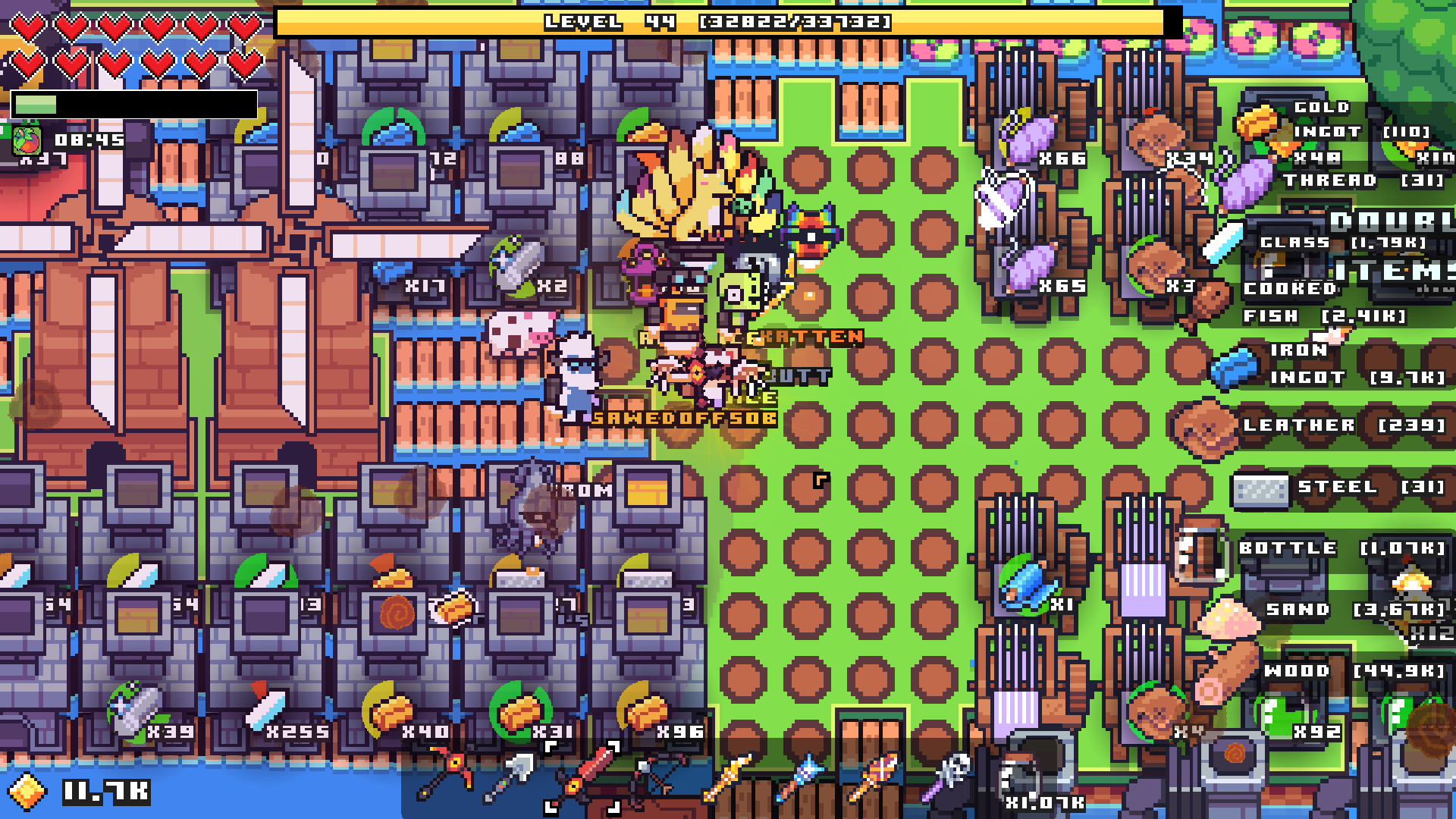
As your production grows, inventory space becomes increasingly important. A larger inventory lets you stay out gathering for longer and reduces interruptions caused by returning to storage.
Organize your resources around their purpose rather than randomly filling every available slot. Keeping crafting materials together makes it much easier to identify what you are missing.
3. Choose Skills With Your Long-Term Economy in Mind
Forager uses a skill system that allows you to unlock different upgrades and specialties as you gain experience. Because skill choices influence how quickly your island develops, it is worth considering what kind of playstyle you want before spending every point.
There is no single skill path that works perfectly for every player. Someone focused on crafting may value different upgrades from someone who wants to explore, fight enemies, or build a highly automated economy.
Prioritize Skills That Remove Repetitive Work
Early in the game, skills that improve gathering, crafting, production, or resource efficiency can have a huge impact because you will perform these actions constantly.
Consider skills that improve:
- Resource gathering
- Crafting efficiency
- Building production
- Inventory capacity
- Economic income
- Experience generation
- Exploration
- Combat
The best early upgrade is often the one that benefits many different activities rather than one that only helps a very specific situation.
Think About Skill Synergy
Some skills become much stronger when combined with specific buildings or crafting systems. Instead of judging a skill independently, ask what it will allow you to do afterward.
A skill that seems modest on its own may become extremely valuable once you have several production buildings operating simultaneously.
4. Buy Land Strategically
Purchasing new land is one of the defining mechanics of Forager. Each expansion gives you more space and access to additional resources, but land prices increase as you continue expanding.
Because of this, blindly buying whichever piece of land you can currently afford is not always the best approach.
Look at What Each Area Provides
Before purchasing land, consider:
- Which resources are available?
- Are there important buildings or structures?
- Does the area contain puzzles?
- Does it unlock a new biome?
- Will it improve your ability to travel around the map?
- Does it provide useful space for production buildings?
A new biome can be much more valuable than an empty piece of land simply because it introduces new resources and progression opportunities.
Expansion Also Creates Building Space
Do not think about land only as resource territory. Later, your island can become heavily developed with furnaces, factories, banks, storage, markets, mining structures, and other production buildings.
Leaving yourself enough room to organize these systems can make your late-game island much easier to manage.
5. Build a Strong Production Network
Crafting everything manually becomes increasingly inefficient as Forager progresses. Production buildings allow you to convert raw materials into more useful resources while you continue exploring and gathering elsewhere.
The key is to stop thinking of buildings as isolated crafting stations and start thinking of them as a production network.
Build Around Resource Chains
For example, one building may process a raw material into an intermediate component, which another building can then use for an advanced item.
A good production setup therefore starts with the question:
What resource chain am I trying to create?
Instead of building ten random structures, establish a few useful production chains and expand them as your needs increase.
Avoid Building More Than You Need
Automation is powerful, but excessive construction can consume valuable resources and space. If you build large numbers of production structures before having enough materials to supply them, many of them will sit idle.
A better approach is:
- Identify an important bottleneck.
- Build the structure that addresses it.
- Supply it consistently.
- Check whether production has improved.
- Expand only when demand increases.
This keeps your island efficient rather than cluttered.
6. Use Money and Selling to Accelerate Progress
Money is extremely important in Forager because it allows you to purchase land and interact with several economic systems. However, selling resources blindly can create shortages later.
The trick is to sell materials strategically.
Sell Surplus, Not Your Entire Stock
If you have hundreds of a common resource and only need a small amount for crafting, selling part of your surplus can provide useful income without damaging your production.
Before selling something, ask:
- Is this used in important recipes?
- Will I need a large quantity soon?
- Is it difficult to replace?
- Am I selling it because I have too much, or because I do not know what it does?
The last question is particularly useful for beginners.
Improve Your Economic Infrastructure
As you unlock more economic options, look for ways to generate income without constantly stopping your exploration to sell items manually.
A strong economy allows you to purchase land faster, which gives you access to more resources and further increases your earning potential.
This creates another important Forager loop:
Better production → more resources → more income → more land → better production.
7. Explore Every Biome and Investigate Strange Objects
Forager is not only about gathering and crafting. Exploration is responsible for many important discoveries, including puzzles, unique resources, special locations, and progression-related objects.
Whenever you unlock a new biome, take time to investigate it rather than immediately returning to your previous routine.
Look for Interactive Elements
If something appears unusual, try interacting with it. Strange structures, statues, signs, puzzles, chests, and environmental objects can often provide rewards or clues.
Do not assume that every object exists purely for decoration.
Prepare Before Dangerous Exploration
Some areas can contain enemies or hazards that are more difficult than the starting zones. Bring appropriate equipment, food, and healing resources before venturing far from your established base.
Exploration is much more efficient when you can stay away from home for a longer period instead of repeatedly returning because your health or inventory is insufficient.
8. Upgrade Equipment and Combat Before It Becomes a Problem
Combat is not the only focus of Forager, but enemies become increasingly relevant as you explore more of the world. Stronger equipment also makes resource gathering and general progression more comfortable.
Do not wait until enemies become a serious obstacle before improving your gear.
Improve Tools That You Use Constantly
Upgrading tools can have benefits beyond combat. Faster gathering means less time spent collecting basic resources and more time available for exploration, crafting, and expansion.
When deciding what to upgrade, prioritize equipment that directly affects activities you perform frequently.
Keep Food Available
Food can provide important benefits and help you maintain your health while exploring. Keeping several useful food items in your inventory means you can continue working instead of returning home after taking damage.
A practical exploration inventory might include:
- Healing or useful food
- A reliable weapon
- Appropriate gathering tools
- Empty inventory slots
- Materials needed for emergency crafting
The goal is to remain flexible rather than filling every slot before leaving your base.
9. Start Automating Your Island
Automation becomes increasingly important as your island grows. At first, manually collecting resources feels perfectly reasonable because everything is close together. Later, the amount of material required for crafting and construction increases dramatically.
Automation helps you solve this scaling problem.
Identify Your Biggest Bottleneck
Do not automate randomly. Look at what repeatedly slows you down.
If you constantly lack a particular processed material, improve the production chain responsible for it. If gathering a particular resource takes too much time, investigate whether buildings or skills can reduce that workload.
The best automation is usually the automation that removes something you are tired of doing repeatedly.
Let Machines Work While You Explore
One of the biggest advantages of automation is that your island can continue producing resources while you explore, fight, solve puzzles, or gather rare materials.
This changes the rhythm of the game.
Instead of:
Gather → Craft → Gather → Craft
you can gradually move toward:
Set up production → Explore → Return → Collect finished resources → Expand production.
That is one of the most important transitions from early-game Forager into an efficient mid-game setup.

10. Optimize Your Island for Late-Game Progression
Once you have unlocked multiple biomes, established production chains, upgraded your equipment, and accumulated substantial resources, Forager becomes less about simply surviving and more about optimization.
At this stage, your island should function like a connected economic machine.
Reorganize as Your Needs Change
Your original layout was probably created when you had very few buildings. There is nothing wrong with rebuilding it later.
Consider grouping buildings according to function:
- Resource processing
- Advanced crafting
- Storage
- Economic buildings
- Farming
- Utility structures
- Specialized production
Keeping related structures close together makes it easier to monitor your economy and identify missing materials.
Focus on Bottlenecks
Late-game efficiency is mostly about finding the slowest part of your production chain.
If you have plenty of raw resources but not enough processed materials, increase processing capacity.
If processing is fast but you lack raw materials, improve gathering or resource generation.
If production is strong but you cannot afford new land, focus on your economic systems.
Always fix the bottleneck rather than increasing production everywhere.
Do Not Forget Exploration
Even when your economy becomes highly automated, exploration remains important. Puzzles, special locations, unique resources, and other discoveries can provide progression that cannot simply be replaced by producing more basic materials.
A strong late-game routine alternates between:
- Checking production
- Collecting resources
- Completing objectives
- Exploring new areas
- Solving puzzles
- Upgrading equipment
- Expanding your island
- Improving automation
This keeps the game moving instead of turning your entire playthrough into resource grinding.
Conclusion
Forager starts as a simple gathering game but gradually becomes a complex combination of exploration, crafting, economics, automation, combat, and island management. The most important skill is learning how these systems support each other.
Early on, concentrate on gathering essential materials, unlocking useful skills, expanding your land, and establishing reliable crafting systems. As your island grows, stop relying entirely on manual gathering and begin building production chains that can supply your needs automatically.
Keep a reserve of important resources, sell surplus materials instead of everything you own, explore every new biome carefully, and upgrade equipment before difficult areas become a problem. Most importantly, pay attention to your biggest bottleneck. Whether the problem is money, raw materials, processing speed, inventory space, or land, solving the current bottleneck will usually provide a larger benefit than upgrading something you already have in abundance.
With a balanced approach to exploration, production, economy, and automation, your small starting island can eventually become a highly efficient resource network capable of supporting even the most demanding stages of Forager.
Description (160 characters):
Master Forager with practical tips for resources, skills, land expansion, crafting, automation, exploration, combat, money, and efficient late-game progression.